BioPure Mini 0.5
DOE at the speed of intuition.
Designed for parallel design-of-experiments runs, the Mini 0.5 lets process scientists characterize critical quality attributes with the throughput of a screening platform and the fidelity of a clinical bioreactor.
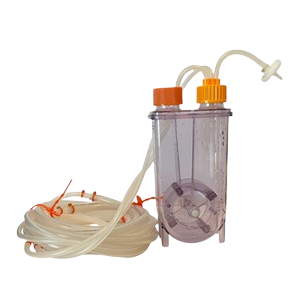
Built for the process optimization stage.
Single-use 0.5L vessel for parallel DOE screening
Optional perfusion configuration for pluripotent stem cells
Same Vertical Wheel geometry — process locks transfer to PBS-3 and beyond
Embedded magnets enable axle-free impeller drive
Five reasons it beats incubation-based minis.
Higher yield, lower cost
Precise DO control overcomes the gas-exchange limits of incubation-based culture — extending the growth phase and doubling viable cell yield per batch.
2× cell yieldFull automation at mini scale
Large-scale automation packaged for development: real-time pH, integrated gassing, recipe building, and remote monitoring from day one.
Recipe + remoteClosed-system operation
Closed sampling, supplementation, and perfusion-based medium exchange — sterility preserved, operator variability eliminated.
Closed sterileSeamless path to scale
True scale-down model. The same Vertical Wheel hydrodynamics carry through 3L, 15L, and 80L GMP production with no re-engineering.
60 mL → 80 LPurpose-built for cell therapy
Engineered for shear-sensitive cells: PSC aggregate homogeneity, MSC viability, CAR-T phenotype — preserved from PD through GMP.
Phenotype safeFrom unboxing to inoculation in five steps.
- Step 01Calibrate
Enter vessel calibration data and prime sensors.
Ch. 6 · p. 63 - Step 02Install vessel
Mount single-use vessel; level adjust to 0 mL.
Ch. 6 · p. 66 - Step 03Prime & fill
Load tubing, prime pumps, dispense medium.
Ch. 6 · p. 76 - Step 04Ramp & inoculate
Set alarms to ramp, equilibrate, inoculate.
Ch. 6 · p. 87 - Step 05Sample / harvest
Sterile sampling, perfusion or harvest line.
Ch. 6 · p. 95
Every parameter you'll close-loop on day one.
Every part. Engineered for living cells.
Scroll to explode the vessel
Engineered for the room you'll put it in.
DO control doubles PSC yield
Total viable cells over a 7-day pluripotent stem cell run.
BioPure Mini 0.5 vs. incubation-based mini bioreactors.
| Capability | BioPure Mini 0.5 | Incubation-based minis |
|---|---|---|
| Real-time DO control | Closed-loop split-range | Not supported |
| Inline pH monitoring | Compendial-aligned | Offline only |
| Closed sampling & perfusion | Integrated | Not supported |
| Parallel cultures from one controller | Up to 24 vessels | Manual setup |
| Scale-down fidelity to GMP | Identical Vertical Wheel hydrodynamics | Geometry change required |
| Recipe automation & remote monitoring | Built-in | Not supported |
Audit-ready out of the crate.
USP Class VI / ISO 10993 contact materials
Gamma-irradiated single-use vessel (SAL 10⁻⁶)
BioLogic™ software — 21 CFR Part 11 audit trails
IQ / OQ documentation packages available
Validated for the modalities you're building.
Every day a cell therapy batch is delayed,
a patient's window closes.
Industry averages compiled from BioProcess International, Alliance for Regenerative Medicine, and PBS Biotech case studies. The Vertical-Wheel® is engineered so a process locked at PBS-3 transfers to PBS-80 without re-validation.
Model your manufacturing economics.
Adjust throughput, capex, and per-batch consumables to estimate cost per dose, annual savings, and payback period vs. your current process.