CFD Characterization of Vertical-Wheel Bioreactors Used for Effective Scale-up of hiPSCs
Narrow EDR distributions are reproduced across 0.1, 0.5, 3, and 15 L volumes — the empirical basis for linear scale-up.
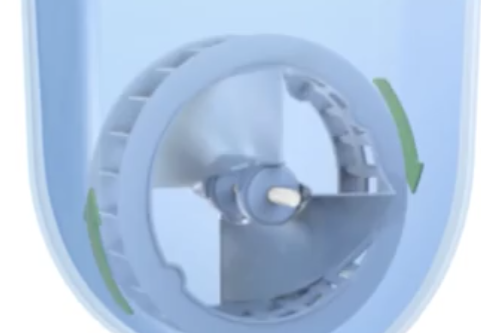
Read paper →Stirred-tank impellers were designed for industrial chemistry, not living cells. Rotation of the Vertical-Wheel® impeller within the distinctive U-shaped vessel fully suspends and gently agitates anchorage-dependent human cells that are sensitive to a bioreactor's hydrodynamic conditions — and the process scales linearly from 60 mL to 80 L.

A geometrically accurate cross-section of the U-shaped vessel, single-impeller hydrodynamics, energy dissipation field, aggregate morphology, and scale-up. Adapted from PBS Biotech technology references, Dang et al. (2021) and M. Lee (2020).
Unlike industrial stirred tanks, the single-use vessel is U-shaped and the impeller axle is horizontal. A single large Vertical-Wheel® occupies most of the cross-section — geometry is the source of the gentle mixing.
Same impeller geometry. Same EDR profile. Same Kolmogorov eddy length relative to particle size. The process you locked at one scale runs at any other — no re-validation, no re-engineering.
The same three-part architecture — disposable vessel, control system, electro-mechanical drive — appears at every scale, which is why a process locked at PBS-3 transfers identically to PBS-80.
Gamma-irradiated single-use vessel — where the cell culture is grown. USP Class VI / ISO 10993 contact materials, axle-free magnetic-drive impeller.
BioLogic™ software stack controlling every aspect of the cell process: PID loops for DO, pH, temperature; recipe automation; 21 CFR Part 11 audit trails.
Sensors, pumps, mass-flow controllers, and the brushless motor driving the horizontal Vertical-Wheel® axle. Designed for cleanroom uptime.
Scroll to disassemble
Neto P.M., Nogueira D.E.S., Hashimura Y., et al. Characterization of the Aeration and Hydrodynamics in Vertical-Wheel™ Bioreactors. Bioengineering 2022, 9, 386. The open-hoop, horizontal-axis, pitched-blade geometry rendered above is the same geometry characterized in this peer-reviewed CFD and PIV study.
CFD models indicate that narrow distributions of energy dissipation rates (EDR) can be achieved at various agitation rates and volumes of Vertical-Wheel bioreactors. The reproducibility of homogeneous EDR conditions is essential for optimal and scalable production of therapeutic cells, particularly those grown as aggregates. Panels below show three agitation rates per scale; distributions overlap tightly within each panel and across panels.
Figure adapted from Dang et al. (2021), CFD Characterization of Vertical-Wheel Bioreactors Used for Effective Scale-up of hiPSCs. Not to scale.
Homogeneous EDR conditions promote formation of spherical aggregates with inverse correlation between diameter and agitation rate. Heterogeneous mixing in horizontal-blade impellers results in variable morphologies. For surface-attached cells on microcarriers, Kolmogorov eddy lengths under Vertical-Wheel hydrodynamics remain larger than the microcarrier diameter — eliminating the shear that strips cells from carrier surfaces.
Homogeneous EDR yields circular aggregates of similar diameter, with aggregate size inversely correlated to agitation rate.
Heterogeneous mixing produces variable, stressed morphologies — a known failure mode for aggregate-grown therapeutic cells.
Figure adapted from M. Lee (2020), Scalable Manufacturing of Allogeneic Cell Therapy Products, RegMedNet.
Across hundreds of validated transfers, BioPure customers report a scale-up R² of 0.99 between bench and commercial volumes — meaning the process you locked at 3L runs identically at 80L.
The Vertical-Wheel® platform is cited in 90+ peer-reviewed publications. Four of the foundational studies are listed below.
Narrow EDR distributions are reproduced across 0.1, 0.5, 3, and 15 L volumes — the empirical basis for linear scale-up.
Read paper →Homogeneous EDR yields uniform spherical aggregates; horizontal-blade impellers produce heterogeneous, stressed morphologies.
Defines the Kolmogorov-eddy criterion that explains why Vertical-Wheel hydrodynamics protect surface-attached cells on microcarriers.
Demonstrates >25× expansion of hiPSCs over 6 days with retention of pluripotency markers across scales.